
 Deutsch
 English


Google Maps for Your Business Model
What is the benefit of Google Maps when planning a trip? It places the destination in relation to a starting point and maps out the most efficient route. The requirements during the planning phase of starting a business are similar. This is exactly where the Lean Canvas comes in: Starting with the problems or needs of the stakeholders (customers), a solution is outlined that demonstrates a corresponding benefit. This benefit is to be understood as the value proposition to the customer and is ever-present (even beyond the planning phase). Additional relevant content is gradually added. Thus, the “startup roadmap” is fully mapped out, and the project can begin.
The benefit, therefore, lies in involving all relevant stakeholders, focusing on customer value, and holistically expanding the framework to include additional, relevant aspects.
Origin
Before delving into the individual components of the Lean Canvas in detail, let’s take a brief look at
the tool’s origins. In his 2010 book *Running Lean*, Ash Maurya describes the Lean Canvas as a “one-page business plan.” His main focus is on identifying customer problems worth solving. Fittingly, he promotes the model with the slogan: “Life’s too short to build something nobody wants!” (leanstack.com, 2018)
Planning Process
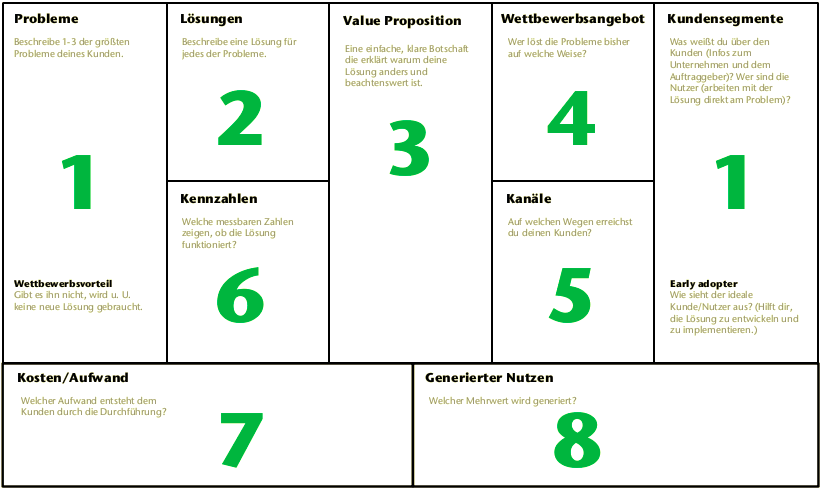
The Lean Canvas consists of nine individual components. The order in which these are addressed varies depending on the specific requirements. For initial guidance, however, I would like to outline my vision of an “ideal” process here. First, it’s important to note that a single startup project doesn’t necessarily require just one Canvas. It’s quite possible that, due to a wide variety of user and customer groups, several different Canvases will need to be created.
Customer Segments
Customers and Users
“Who are the customers and users of the results?”
The relevant stakeholders are listed here. But what is the difference between customers and users? Customers and users are not always distinct. However, the criterion of payment can be used to differentiate between them. Customers pay for the product. eBay allows bidders to shop for free. The seller, on the other hand, pays a percentage-based fee. In this case, the bidder is the user and the seller is the customer. It is important to understand that the stakeholder groups—customers and users—initially provide the problem and, as the project progresses, represent the most important source of feedback and thus for the project’s further development.
Early Adopter
The early adopter is the ideal customer or user. They are someone who is willing to provide feedback and test your ideas without much hesitation. They already have relevant prior knowledge and understand your approach better than other customers and users.
Problems
“Describe your customers’ 1–3 biggest problems!”
This section is at least as important as identifying customers and users themselves. It forms the foundation for every product, because without a problem, there’s no reason to design a solution. Depending on how you’ve segmented customers and users, you’ll need to apply the same segmentation here. This ensures that the right problems are assigned to the right target groups.
Competitive Advantage
“Something that makes it difficult for others to copy the solution!”
Why is the product you’re aiming to create better than a potential competitor’s product? What are you striving to achieve that existing alternatives don’t already provide? This is what will determine the success or failure of your startup’s future activities.
Solutions
“Describe a solution for each of the problems.”
Now it’s time for the actual work on the project: generating a solution. How will you solve the problems faced by customers and users?
Value Proposition
“A simple, clear message that explains why your solution is different and worth paying attention to!”
This is the central aspect of the Lean Canvas and, therefore, of the startup venture as well—the actual goal. This message succinctly summarizes what the customer or user can expect from your company. It’s essentially the answer to the question: “Why should I be interested in this product?”
The easiest way to explain this concept is with an example. Airbnb, for example, uses the message: “Book unique accommodations and experience the city like a local.” It first addresses the solution (“Book unique accommodations”) and then, in the second part, highlights the added value for the user (“... experience the city like a local”). It’s immediately clear to the reader what they stand to gain from using the service. The question of why they should use Airbnb is answered.
Competitive Offer
This section is crucial and is closely linked to the competitive advantage. The question that should be asked in the context of any startup is: “Are there alternatives to the intended product?” Above all, those that can be implemented with less time and cost are relevant here.
Key figures
“What measurable metrics show whether the solution works?”
At this stage, the project is quantified and made measurable. With the help of appropriate key metrics, the project should be validated step by step and the results made reproducible. Possible questions when determining key metrics include:
- Does the customer/user actually have the problem I’ve identified?
- Does my solution work/does it add value?
- Is the intended benefit being achieved?
- How well does each channel perform?
- Are the costs too high?
- and much more
These questions serve as the starting point. From here, we must answer the question: “How can I make this measurable?”
Channels
“How do you reach your customers?”
How are customers reached? What different touchpoints are there (e.g., pre-sale, at-sale, post-sale)? The primary focus is on product development from the customer’s/user’s perspective. The necessary feedback is gathered through the appropriate channels. The channels also play a crucial role in determining key metrics. If, for example, you want to set up a blog, the following question arises: “How can I be sure that my users are actually deriving value from it?” The answer is crucial for determining how to proceed. Therefore, a suitable channel must be found to survey users. In addition, a metric related to that channel is needed to measure success. In this example, the channel could be a newsletter with a link to an initial demo blog page. The click-through rate then provides insight into user behavior.
Cost
“What effort is involved in carrying this out?”
All costs incurred as the startup progresses must be listed here, for example:
- Personnel costs
- Training costs
- Development costs
- Marketing
- Material costs
- and much more
Generated benefit
“What value is generated?”
The Lean Canvas summarizes the revenue generated by the product at this point. This means that the various revenue-generating opportunities are aligned with the pricing models here.
Together with the costs, you can then get an initial sense of profitability. For example, you can compare revenue per customer with direct costs per customer. This allows you to estimate how many customers are needed to cover fixed costs on the one hand, and to forecast your profit on the other.
The second part on the Lean Canvas focuses on implementing your project and how the Lean Canvas can support you in this process.
Published on April 27
, 2021 Author: Marcel Heine