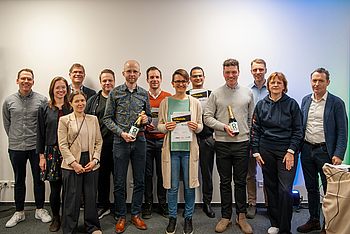
Recap TUniCorn 2026
The fourth edition of TU Clausthal’s start-up ideas competition once again took place under the joint leadership of TU Clausthal’s Start-up Service and the Wirtschaftsförderung der Region Goslar (WiReGo), providing a platform for innovative projects – including English-language submissions for the second time. At the closing event on 05 March 2026, the jury selected three winning teams.
With 18 applications received, the competition set a new record this year. Eight projects made it to the final and presented their ideas to an audience and jury at TU Clausthal’s Start-up Centre. The jury panel comprised Iris Seeber (Volksbank im Harz), Samet Kibar (WiReGo), Christian Schäfer (Fels Werke GmbH) and Michael Reiss (Holos Excellence), joined for the first time by Prof. Dr. Ani Melkonyan-Gottschalk.
A further highlight of the evening was a guest talk by Emil Alkountar, founder of or et vin - a perfume start-up born right here in Clausthal-Zellerfeld. Sharing his personal entrepreneurial journey, he captivated and inspired all those in attendance – a compelling testament to the start-up potential that Clausthal has to offer.
The Eight Finalists of TUniCorn 2026
The eight finalist teams demonstrated the remarkable breadth of this year’s competition: QuinAir (a novel air-redox-flow battery for seasonal energy storage), Rotor (recycling of GFRP rotor blades from wind turbines), Clara (AI-powered voice documentation for care professionals), Peregrine Dynamics (AI-assisted morphing wing for fixed-wing drones), LV2CAD (AI-driven workshop planning from bills of quantities), Norscope (offline augmented reality for industrial maintenance), sortIQ.ai (AI-based sensor fusion for pre-sorting e-waste), and OptiLift (intelligent demand-aware elevator operation).
The Winners of TUniCorn 2026
1st Place
QuinAir
QuinAir is set to transform seasonal energy storage through a novel combination of redox-flow and metal-air battery technology. Targeting costs of under €34/kWh alongside high energy densities, the concept addresses one of the energy transition’s most pressing bottlenecks: the long-term, seasonal storage of solar power.
Dr.-Ing. Marina Becker, Dr.-Ing. Maik Becker
2nd Place
Rotor
Rotor develops a continuous pyrolysis process for the material recovery of GFRP rotor blades from wind turbines. Rather than the climate-damaging downcycling common in the cement industry, the approach recovers glass fibres as well as oil and gas fractions from real, heterogeneous rotor blade materials – opening a genuine recycling pathway for one of the wind industry’s most persistent disposal challenges.
Maximilian Feyrer, Philipp von Güldenstubbe
3rd Place
Clara
Clara tackles one of the most pressing issues in professional care: the burden of documentation. A hands-free, natural-language AI system enables care workers to document directly during their work. Spoken content is transcribed, semantically analysed, structured and transferred into care management software in a compliant format – multilingual, offline-capable and fully data-protection compliant.
Zaki Hussein, Dominik Schulz, Prof. Dr. David Unbehaun
Jury Impressed: Follow-Up Planned for Six Months’ Time
A particular highlight of this year’s competition: the jury was so impressed by the quality of all eight finalist teams that they unanimously expressed their interest in a follow-up meeting. In approximately six months’ time, the jury members would like to hear how the projects have progressed and are offering the teams further personal support. The format will be organised by TU Clausthal’s Start-up Service – a strong signal for the lasting connections being built between academia, business and entrepreneurial culture in the region.