
 Deutsch
 English

Lean Startup
According to a study by the business analytics platform “CBS Insights,” a lack of customer demand is one of the main reasons startups fail. In addition, it’s common for startups to run out of funding before they can gain momentum, for potential customers to be overlooked, or for competitors to beat them to the market. The Lean Startup approach is one way to address these issues. Find out what the Lean Startup is, how it works, and how you can apply it in the following post from our “Startup ABC” series.
What is Lean Startup?
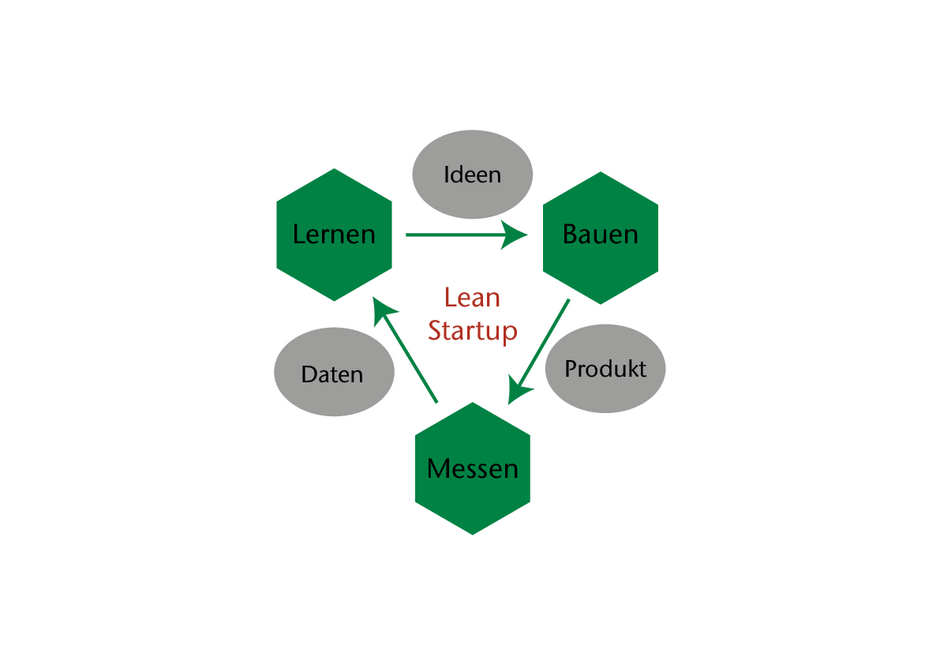
Lean Startup is a method aimed at building a startup “lean”—that is, as quickly as possible and in a way that conserves resources. At the heart of the method is the Minimum Viable Product (MVP) and a repetitive cycle of “build – measure – learn.” The goal is to learn as much as possible about potential customers and their requirements for a product as quickly as possible, and thus to build a business around that product in a short time and with relatively few resources.
How exactly does the Lean Startup method work?
Even though the cycle is called “Build – Measure – Learn,” the method actually begins with learning. It starts by determining whether the target audience actually has the problem we assume they have. So the following question needs to be clarified: Does the target audience view the problem we’ve identified as such, and do they want a solution for it?
This can be determined very effectively through interviews and observations, which is why these often form the starting point of the Lean Startup method.
If it turns out that our target audience does indeed have the problem we’ve assumed and wants a solution for it, we need to start building as soon as possible—specifically, by creating a landing page for a smoke test (you can find our blog post on smoke tests here) or our first MVP. Next comes the measurement phase. To prepare for this, we first need to determine which results and observations indicate that our target audience views our product idea as a potential solution to their problem—and which results and observations suggest we should abandon our product idea. Clarity on this point is important so that we can ultimately work with the results of the measurement phase and not get lost in their interpretation. Once these aspects are clarified, we launch our landing page or our MVP and observe what actions our target audience takes. We record these and carry them forward as findings into the next phase of learning. In the learning phase, we assess whether the findings support keeping or discarding our product idea and what they tell us about necessary adjustments to the product idea. Immediately afterward, we re-enter the building phase and start the cycle over with a new MVP.
The Lean Startup Experiment
Incidentally, the entire run of a cycle is called an experiment, and—contrary to what it might seem—the goal is not to complete it as quickly as possible, but to derive as much learning as possible from it. Therefore, it is wrong to rush through one phase if another suffers as a result. Experiments are also planned in a backward-looking manner. This means that before starting the experiment and beginning the development phase, we ask ourselves what we want to learn and what measurements we need to take to achieve that. Only then do we build and launch an MVP or a landing page suitable for that specific measurement.
With that in mind: Have fun experimenting!
Published on August 13, 2021
Author: Frauke Leuckefeld