
 Deutsch
 English

Why Startups Fail Far Too Often and Far Too Early
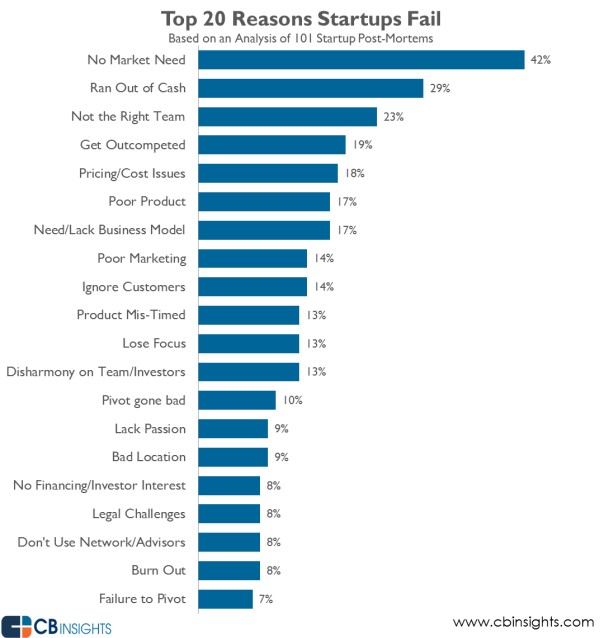
Starting a business is generally considered a rather risky endeavor. This fact becomes all the more apparent the more innovative the idea or business model is. According to a study by the business analytics platform CB Insights, the main reason startups fail is the lack of actual customer demand.
This means that many ideas are simply developed without taking customer needs into account. Although the products or services offered have often been developed at great expense in terms of time and money, they fail to resonate with the target customers.
The founders and their employees may have failed to test early on whether the envisioned market actually exists. A successful product or service must do more than just be technically sound. Above all, the team must understand the customer’s needs, whether these needs are met by the offering, and whether meeting those needs also results in a sufficient willingness to pay. To answer these questions as early as possible and with minimal effort, one effective approach is to conduct a smoke test.
What a smoke test is and how it helps here
The term “smoke test” originated in the field of programming. It primarily refers to a test designed to detect the simplest errors in software that would otherwise make a rollout impossible at an early stage. Smoke tests are sometimes conducted even before more in-depth testing by a dedicated test team. Simple questions such as “Does the software start?” or “Does the user interface even open?” are the focus of smoke tests.
Eric Ries, author of the book *The Lean Startup: How to Start a Business Fast, Risk-Free, and Successfully*, has adapted the concept for startups. Instead of testing for early bugs in program code, as in software development, the concept is applied to startups to test the most critical early assumption: whether there is actually a demand for the planned offering.
According to Ries, a smoke test for startups consists of a one-page website, a landing page. This page describes the product and asks visitors to sign up for a newsletter or mailing list to receive further updates. At this stage, the product has not yet been developed, but a high number of registrations indicates interest from potential customers and allows one to draw conclusions about whether the startup’s solution will actually meet a demand. Since nothing has been developed yet at this stage, the startup can take corrective action without significant losses if there is a lack of interest. If, on the other hand, people show interest in a product that exists only as a concept, the founding team should continue down this path.
Ries emphasizes, in particular, that it is important to test willingness to pay at an early stage. Providing an email address can be considered a form of payment. However, it is also possible to include a payment button early on. Such a test may exclude a relatively larger number of potential customers. If it is successful, however, it sends an even stronger signal to keep going. At the same time, the money can be reinvested into faster development or improving the quality of the solution.
A smoke test can be implemented using simple methods. For example, various providers offer the option to create a landing page for free. The challenge then lies in being able to show it to potential customers. To do this, it makes sense to run an advertising campaign. Even with small budgets, you can run relatively simple yet effective campaigns using Google Ads or Facebook, for example. If you’d like to learn more about designing and conducting smoke tests, feel free to reach out to the Clausthal University of Technology’s Startup Service. The best way to do this is to use our initial consultation form or contact us by email or phone.
Published on July 26
, 2021 Author: Marcel Heine