
 Deutsch
 English

Events #1: Entrepreneurship Skills
What skills do founders and others who want to bring entrepreneurial ideas to life need? This question is on the minds of both the team at Clausthal University of Technology’s Startup Service and researchers and faculty members worldwide, and there are many—sometimes quite different—answers to it.
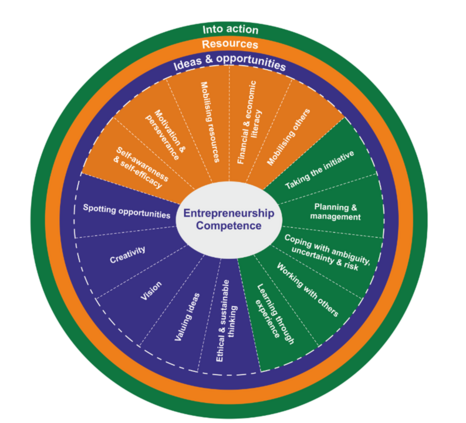
The EntreComp's startup and entrepreneurship competences.
One of the answers comes from the Joint Research Center, the European Commission’s in-house scientific service. In a research project conducted from November 2014 to March 2016, its researchers reviewed the existing literature on startup and entrepreneurial competencies, examined 42 different initiatives in which these competencies are defined, taught, or assessed, and conducted interviews with experts in the field. They then published the results of their work in 2016 with the release of EntreComp, the Entrepreneurship Competence Framework. According to the framework, entrepreneurs need 15 different competencies, including creativity, the ability to identify opportunities for value creation, and a basic understanding of finance and economics.
The startup and entrepreneurship competences of the TU Clausthal
However, since the EntreComp competencies overlap in some areas, the team at Clausthal University of Technology’s Startup Service has condensed and slightly adapted the EntreComp competency model. The result is a model comprising the following nine competencies:
Recognizing opportunities and developing ideas: Identifying opportunities for value creation through problem analysis, market analysis, or the recognition of new connections. Developing creative ideas to capitalize on these opportunities, recognizing and protecting their value, and developing a vision for them.
Reflecting on and developing one’s own personality: Identifying one’s own needs and desires; recognizing and improving one’s own strengths and weaknesses, as well as those of one’s team. This competency also involves maintaining one’s own motivation and that of one’s team despite pressure or adverse circumstances.
Mobilize and use resources and support responsibly: Be able to secure the resources and support needed to realize one’s own ideas and use or deploy them responsibly.
Economic understanding: Understanding and effectively applying economic concepts, terms, key metrics, and methods relevant to the implementation of one’s own ideas.
Management skills: Being able to implement one’s own value-adding activities in a planned manner and using appropriate methods.
Managing uncertainties and risks: Assessing and mitigating risks and uncertainties associated with implementing one’s own ideas.
Collaborating with Others: Be able to establish contacts with others, develop and implement ideas together with them, and manage and resolve conflicts.
Learning from experience: Be able to reflect on one’s own and others’ experiences to identify successful methods and approaches and integrate them into current processes or avoid repeating mistakes.
Developing products: The ability to determine product, service, or process requirements; develop tests and prototypes; and use feedback to gradually optimize products, services, or processes.
Using this model, the Start-up Service team has identified courses at Clausthal University of Technology that teach you the skills needed to start your own business. Many of these are now listed in the course catalog under the heading “Start-up Skills and Entrepreneurship.” You can find out whether you can receive academic credit for attending these courses in the module handbooks and program guidelines for your degree programs. If you’d like to know more specifically which courses teach which skills, simply take a look at the PDF document below.
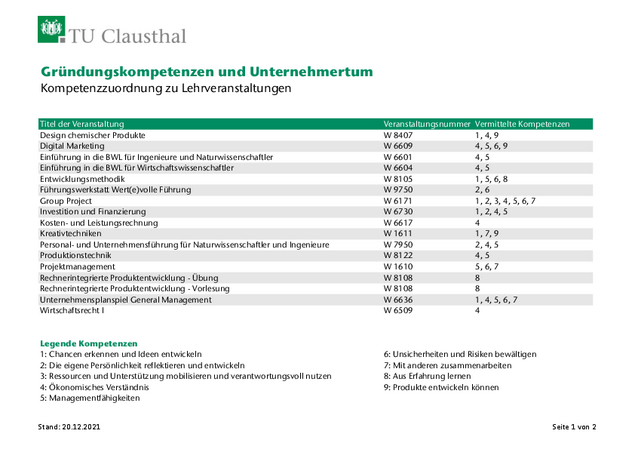
Download:
Courses_Startup_Skills_and_Entrepreneurship_21122021.pdf
Published on October 13, 2021
Author: Frauke Leuckefeld