
 Deutsch
 English

Megatrends—How They Influence the Success of Product Innovations
Why some product ideas succeed and others don't has a lot to do with the needs and interests of market participants and target audiences. But how does a product go from being a hype to a trend? In this article, we'll show you how megatrends influence the success of product innovations.
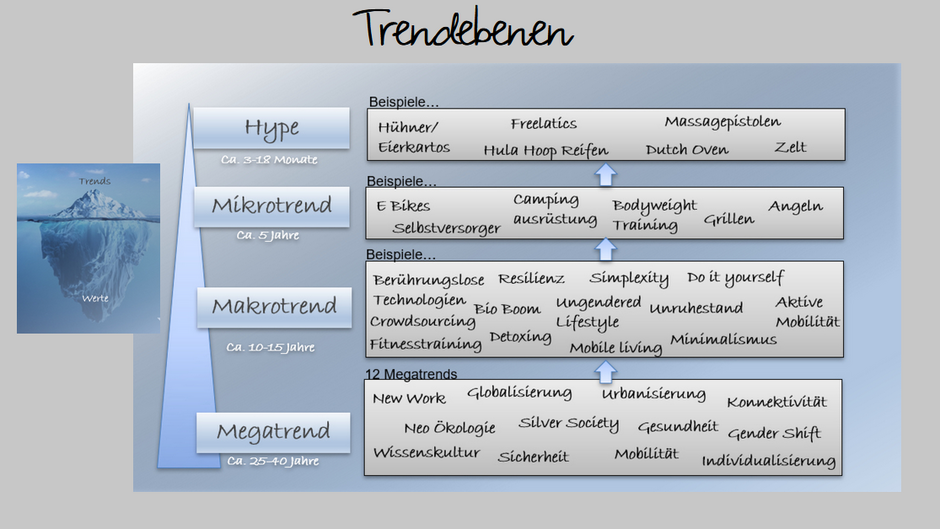
The Trendlevels
Products that can successfully thrive in the market fulfill the conscious or unconscious desires and needs of a large group of market participants. These needs may, for example, vary by region or culture and, above all, persist over varying time periods. They thus reflect the various levels of trends.
Based on the twelve defined megatrends—which shape the global population over a period of approximately 25 to 40 years—derivative macrotrends (lasting ten to 15 years) emerge, microtrends (spanning approximately five years), and short-term fads (lasting approximately three to 18 months). As one moves from the megatrends down to the level of fads, the number of interested market participants steadily decreases. Regional characteristics, individual interests, and other factors lead to a narrowing of focus and specialization within the individual subject areas. Among other things, the megatrend “mobility” gave rise to the macrotrend “active mobility” (including the bike boom). At the microtrend level, this further specializes into the “e-bike” trend, for example.
From Trend to Hype—and Back
The example of “tent” shown in the figure—among others—as a hype product stems from the microtrend “camping gear,” which is rooted, among other things, in the macrotrends “minimalism,” “Mobile Living,” “Active Mobility,” and “Resilience”—and thus in the megatrends “Mobility,” “Individualization,” and “Health.” This example clearly demonstrates that successful products are often based on multiple megatrends and macrotrends. As a current hype product, the tent therefore has great potential to succeed in the market over the long term and may even become a microtrend itself, giving rise to other hype products.


The Starting Point for Successful Innovations
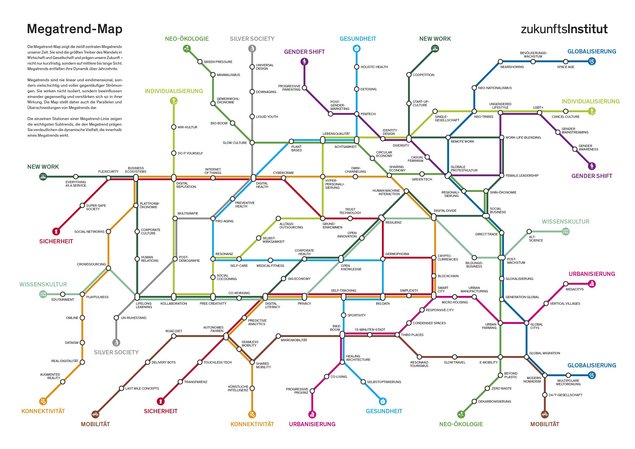
Conversely, this analysis shows that, in our search for successful product innovation, we should focus as much as possible on areas where multiple mega- and macro-trends (and the customer needs they reflect) intersect. Such products have a particularly broad and deep foundation for market success.
The Zukunftsinstitut’s Megatrend Map (Fig. 2) is particularly helpful as a guide here. It shows the current megatrends and the resulting macrotrends and overlaps. You can find the Megatrend Map here: https://www.zukunftsinstitut.de/artikel/die-megatrend-map/
The “bike boom” mentioned at the beginning, for example, is evident here at the intersection of the megatrends “mobility,” “urbanization,” and “health” (see Fig. 3). Accordingly, intersections depicted on the map where two or more megatrends overlap can serve as interesting starting points for developing successful product innovations. The “Digital Health” intersection, for example, represents a convergence of as many as four megatrends (see Fig. 4) and thus holds great potential for future successful products.
More information on the individual megatrends and their underlying macrotrends can be found at: https://www.zukunftsinstitut.de/artikel/megatrend-glossar/
Product Innovation: New Development or Improvement?
In addition to understanding trends and fads, it is, of course, important to understand how a product innovation can come about. There are essentially two ways to do this: new product development and product improvement.
In our chosen example of a tent, the hype is driven by a deeper understanding of customer needs and the resulting improvements to existing products: Successful products in this sector are primarily made from ultralight materials, can be set up particularly quickly (keyword: “pop-up tent”), and thus meet the needs of the current target audience.
You’ll find more on the topic of “New Product Development vs. Product Improvement” soon in another post on product innovations here on our blog, “Lese&Gründe.”
Published on June 18
, 2021 Author: Daniela Stürmer